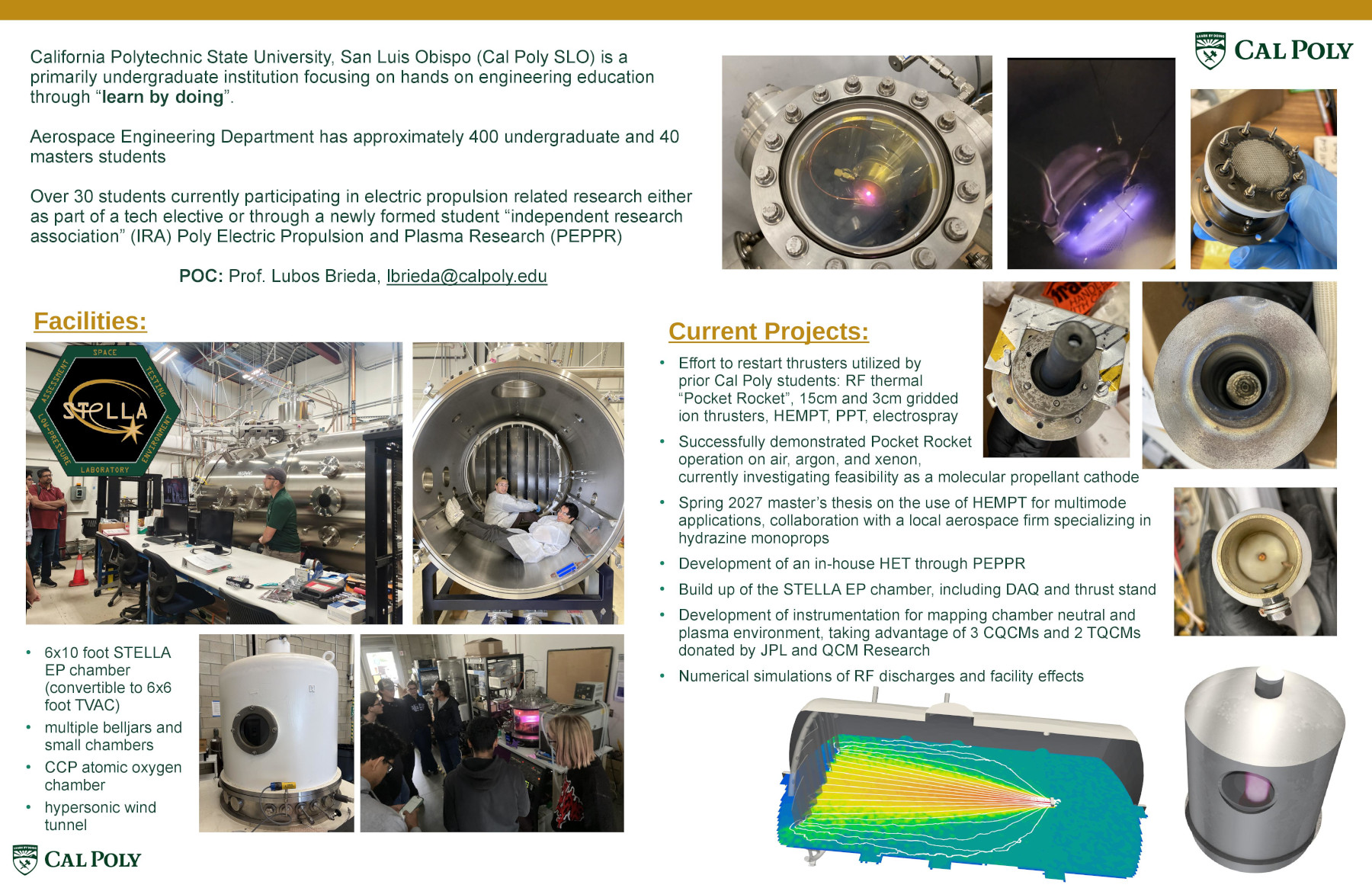
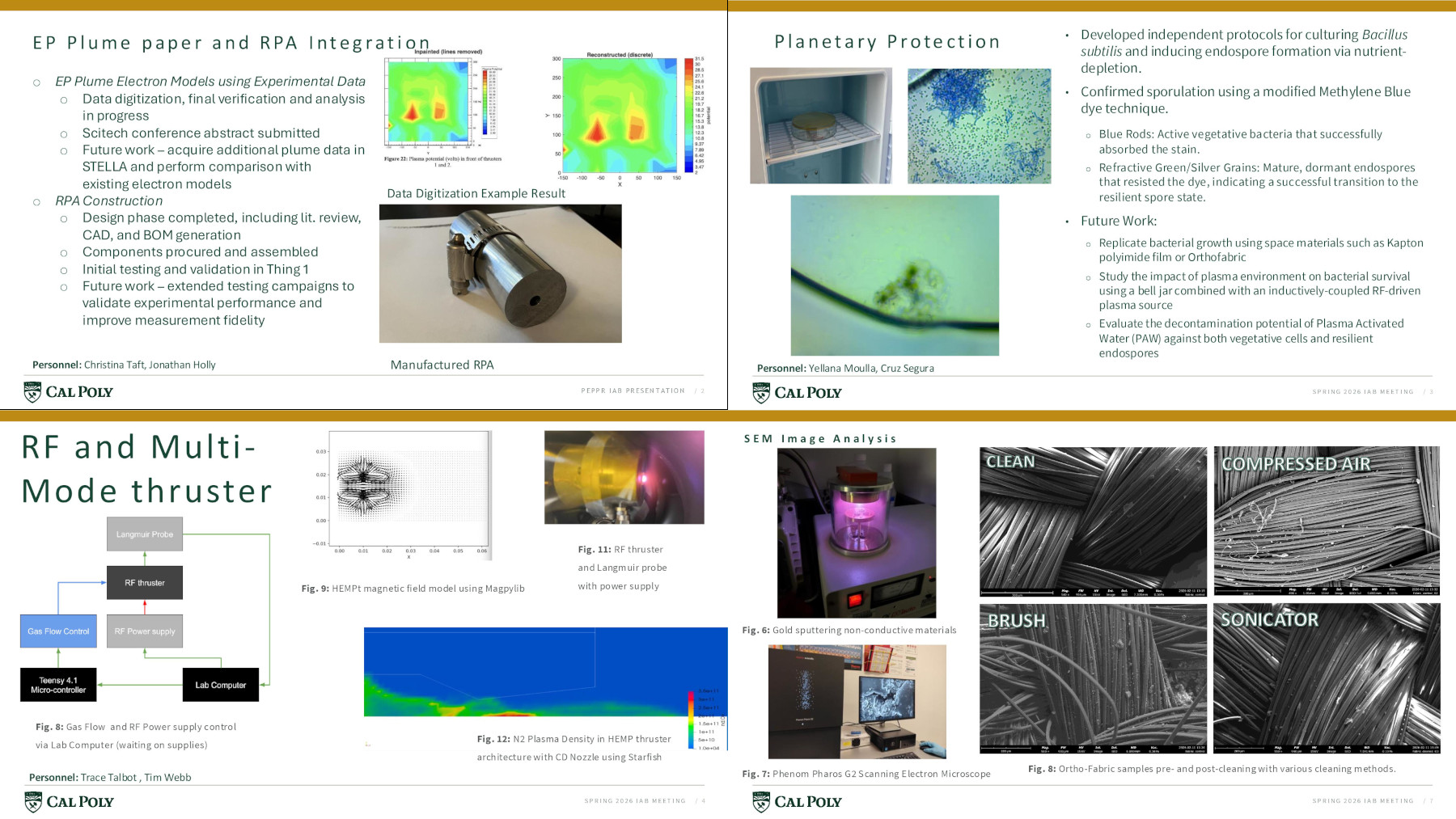
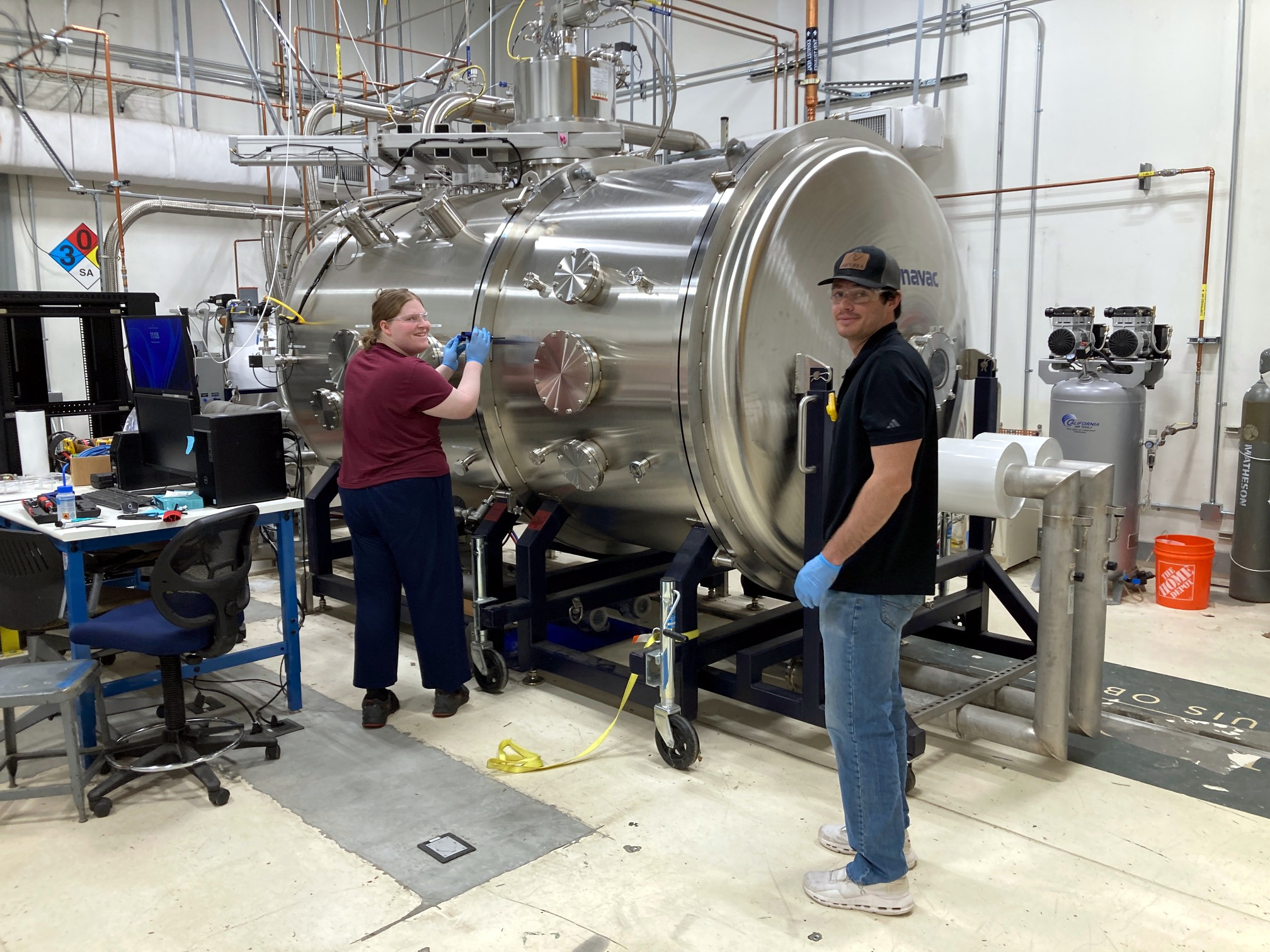
Our research group focuses on a variety of topics related to plasma physics, plasma propulsion, spacecraft contamination transport, and lunar regolith adhesion.
People
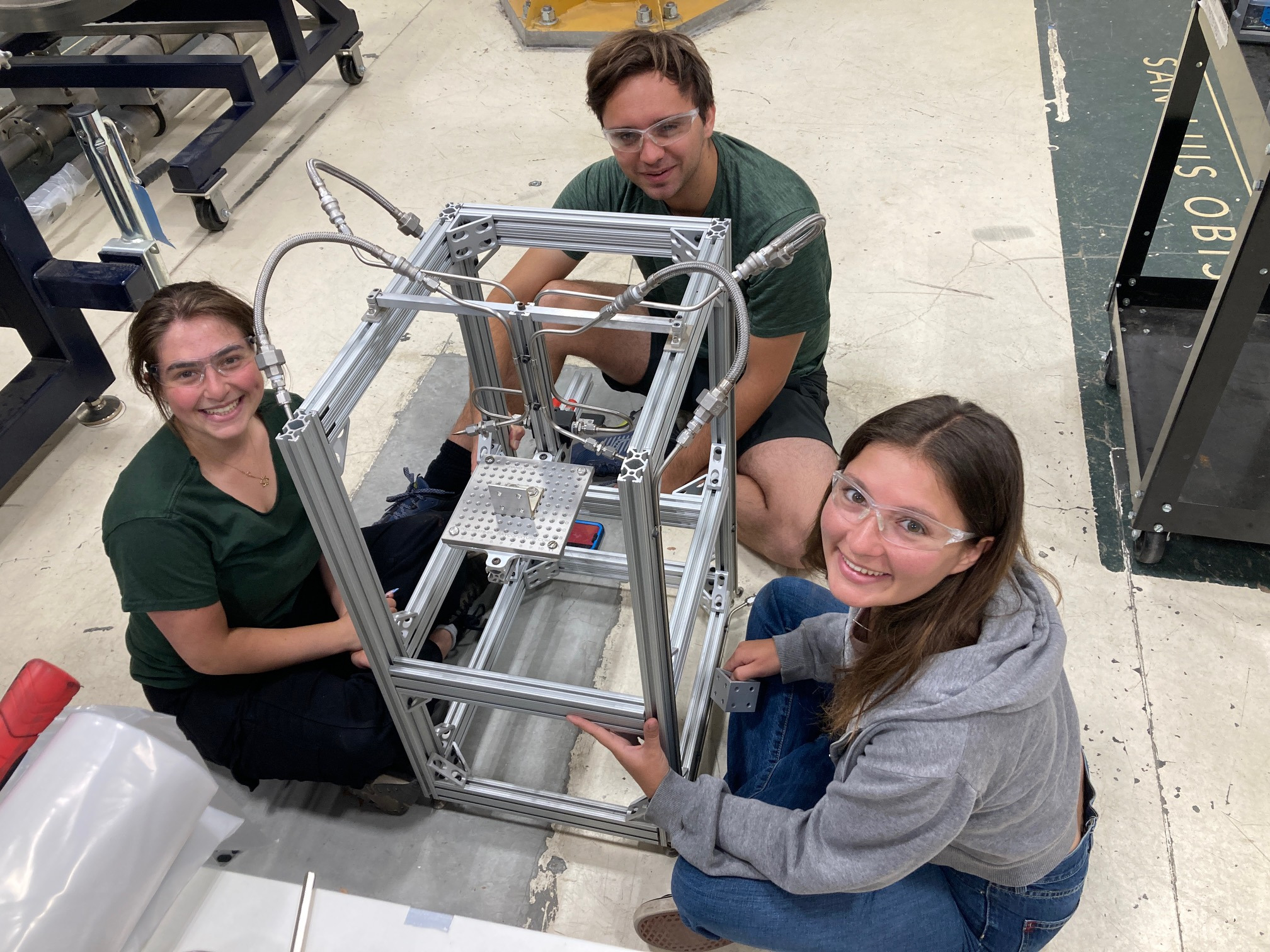
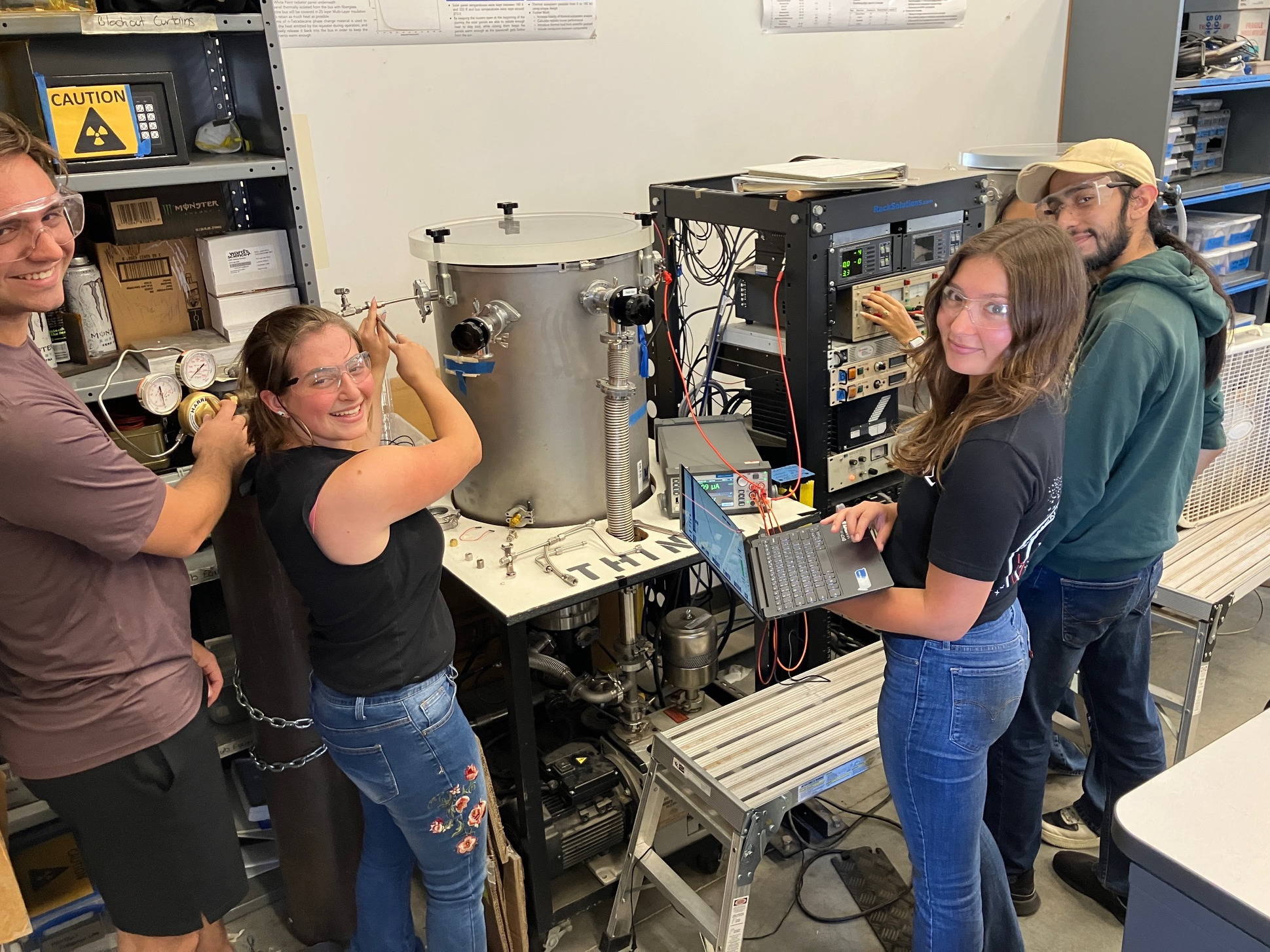
PolyPRG is primarily composed of undergraduate students from the Cal Poly Aerospace Engineering department (AERO), but also has representatives from Mechanical Engineering (ME), Electrical Engineering (EE), and Computer Science (CSC).
Undergraduate Students: Natalie Babic, Spencer Biernat, Ivana Franco, Juan Godina, Jonathan Holly, Tristin Koury, Alan Kusparmakov, Jackson Mehiel, Yellana Moulla, Cruz Segura Sohail Sharma, Christina Taft, Eddy Tapia, David Tennant, Calla Woodruff
Radio Frequency (RF) plasma sources: Using a combination of experiments and numerical simulations, we are investigating plasma formation in capacitively (CCP) and inductively (ICP) coupled plasma sources. Specifically, we are investigating the impact of non-uniform waveforms on the properties of plasma. Preliminary results were presented at the 2026 ICOPS (pdf). Parts of this effort are being funded by the CSU STEM-NET initiative.
Lunar habitat cleaning methods: We are using lunar and martian soil simulants to investigate the effectiveness of various cleaning approaches to remove regolith from the internal zones of future lunar habitats. This effort was funded by the California Space Grant Consortium, with preliminary updates presented at the 2026 AIAA Region VI Student Conference (pdf). An update is planned for 2027 AIAA SciTech.
Multimode Propulsion: The objective of this task is to develop a prototype spacecraft thruster that could operate in a high-efficiency "electric propulsion" mode on propellants used in standard monopropellant chemical thrusters.
Plume Modeling: We are developing various simulation codes for modeling plasma plumes and their interactions with spacecraft or vacuum facilities. This involves new algorithms that couple the "device" and "plume" region as well as codes that can resolve detailed geometries by directly utilizing un-meshed CAD geometries. Preliminary results were presented at the 2026 AIAA Region VI Student Conference (pdf), and a follow up is planned for the 2027 AIAA SciTech.
Electron Models: Kinetic plasma simulation codes typically do not model electrons directly and instead used some fluid model. The validity of various common models is being explored by comparing simulated plasma potentials to experimental data.
Plasma Sterilization: Plasmas are also used in biological applications, including wound healing and surface sterilization. While it is generally known that bacterial spores are highly resistant to plasma irradiation, we are investigating the use of plasma to reduce biological burden in context of planetary protection. This effort is envisioned to lead to a laboratory exercise for the required Space Environments class.
Plasma Diagnostics: We are also building various plasma diagnostics, including Langmuir, Faraday, and RPA probes. Much of this effort was conducted as part of the 2026 Summer Undergraduate Research Program (SURP).
Molecular Outgassing: Outgassing of volatile materials can lead to degradation of spacecraft optical sensors or thermal control surfaces. TVAC testing can be particularly problematic, since outgassed molecules may end up bouncing around the chamber. We are working on characterizing the chamber molecular environment by obtaining two-dimensional maps of contaminant concentration.
Get Involved
Current Cal Poly student and interested in our research topics? If so, you can come discuss current opportunities with Prof. Brieda, and then join the group under AERO-4400 Independent Research class, or as a graduate student working on a thesis project. You may also want to join PEPPR, the Poly Electric Propulsion and Plasma Research student-led "Independent Research Association".